15 de July de 2026
OdourCollect: The Platform That Transforms Odour Complaints into Environmental Evidence
This service uses citizen science to document odour pollution and provide evidence that helps improve environmental management and public decision-making.
Odour pollution is one of the most difficult environmental problems to measure and manage. Although it is often perceived as a minor nuisance, prolonged exposure can significantly affect quality of life, rest, emotional well-being, and people’s relationship with their surroundings. It can also have economic implications, such as reducing property values and affecting the tourism sector. Because odours are variable, intermittent, and subjective, they have historically been difficult to regulate. As a result, many affected communities struggle to demonstrate the existence of the problem and obtain effective responses.
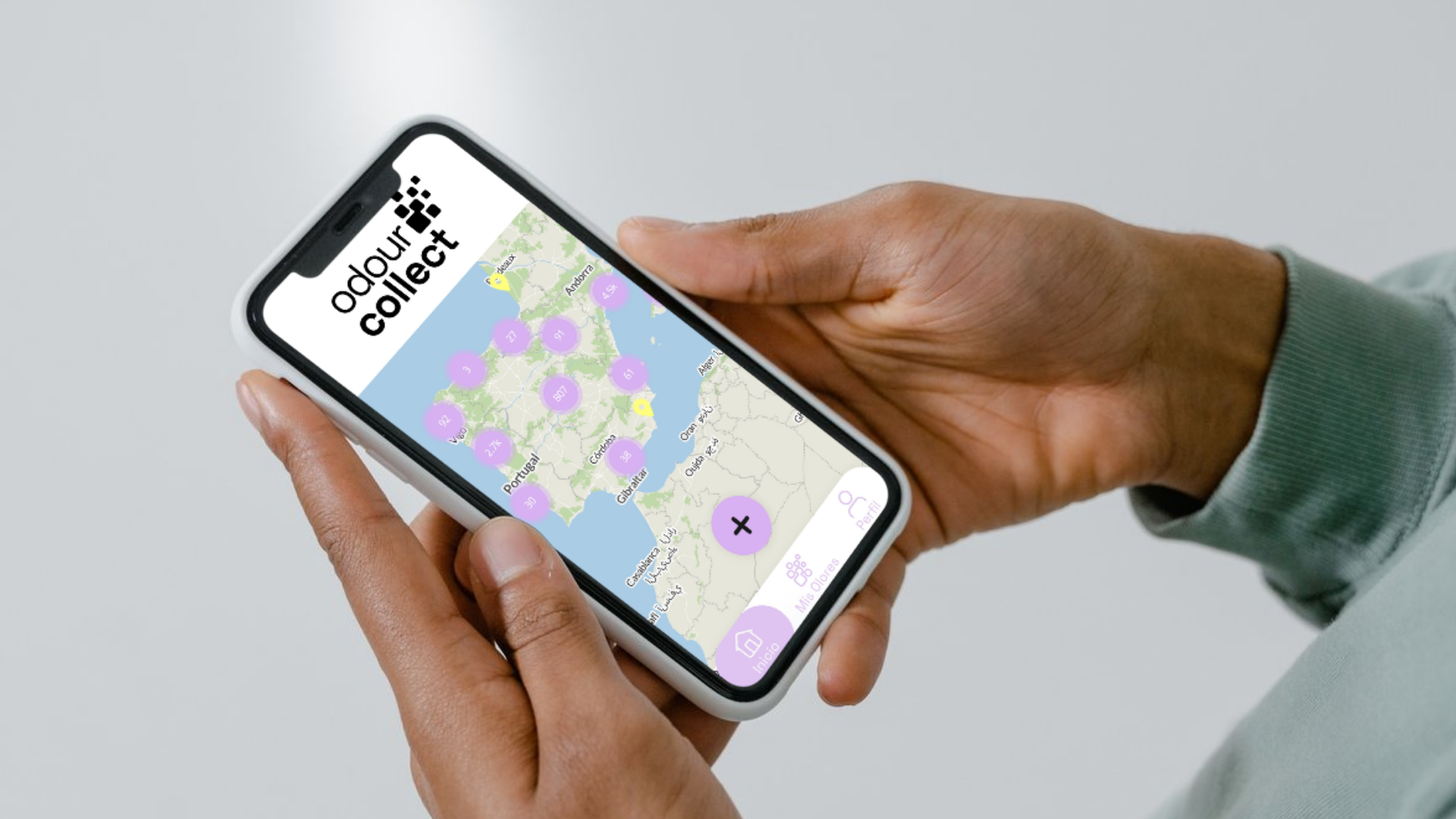
To address this challenge, OdourCollect, a citizen science platform developed by Science for Change, allows users to record odour episodes in a simple and structured way. Through the app, anyone can report the type of odour, its intensity, and its hedonic tone (whether it is pleasant or unpleasant), making it possible to assess the level of nuisance experienced at a specific place and time.
The information is transformed into collaborative maps that help visualize spatial and temporal patterns, identify critical areas, and provide useful evidence for decision-making. The app, which is free to use, sends the collected information to an environmental management platform that calculates odour episodes and the associated nuisance level in accordance with the current standard (UNE 77270:2023 – Construction of Collaborative Odour Maps Using Citizen Science). It also enables alerts to be sent to odour-emitting facilities so they can address the problem in real time and reduce its impact on nearby communities.

An Environmental Problem with Everyday Impact
Unpleasant odours are more than just an occasional inconvenience. When they occur repeatedly over time, they can disrupt daily routines, limit the use of public spaces, create tension among neighbours, and influence how people perceive certain neighbourhoods or residential areas.
However, documenting odours is not always easy. They may appear for only a few minutes, depend on weather conditions, or occur only at specific times of the day, making them difficult to capture using conventional monitoring methods.
“Many people affected by odour pollution know the problem exists, but they do not always have the tools to demonstrate it systematically,” says Rosa Arias, founder and CEO of Science for Change and creator of OdourCollect. “OdourCollect transforms individual experiences into collective evidence.”
Citizen Science to Broaden Environmental Understanding
Citizen science offers a new way of observing environmental problems. Instead of being passive recipients of information, citizens actively participate in generating knowledge. In the case of odours, the combined contribution of geolocated observations provides valuable information about a complex phenomenon that is difficult to capture through occasional measurements alone and that depends on human perception.
This approach does not replace traditional scientific methods or official monitoring systems—it complements them. By incorporating participatory data and local knowledge, it contributes to a more complete understanding of the problem. It also promotes transparency, improves communication between citizens and public authorities, and supports public policies that are better aligned with local realities.
“Citizen science makes it possible to observe what often falls outside conventional monitoring systems,” Arias explains. “When participation is structured through a rigorous methodology, citizens’ perceptions become a unique dataset that enables action in real time and at the right location.”
Spanish Innovation to Improve Odour Management
Developed with support from CDTI under the NEOTEC programme, promoted by the Spanish Ministry of Science and Innovation and funded by the European Union – NextGenerationEU, the OdourCollect environmental management platform provides valuable information for citizens, researchers, public administrations, odour-emitting facilities, and companies committed to sustainability.
The platform is already being used in real-world cases in Catalonia, including Vilanova i la Geltrú, where it is helping improve understanding of the problem and fostering more transparent dialogue between stakeholders.
To date, OdourCollect has collected more than 15,000 odour observations from over 3,000 participants across all five continents.
“OdourCollect demonstrates that technological innovation and citizen participation can work together to address concrete environmental challenges,” concludes Rosa Arias.
Download the App here! OdourCollect
Compartir en